Investigating a chaotic self-oscillating sunlight-driven polymer actuator using Linkam’s THMS600

THMS600 shown above

In nature, it is common to find self-oscillating systems. These systems are either self-regulated or respond to external stimuli. Recreating this process synthetically is of great interest to scientists yet currently, there are only several attempted examples, all chemically driven and within non-dry systems. However, a light driven non-invasive system which would work in dry environments would prove to be much more useful. 

Self-oscillating actuators would have incredible application in self-cleaning devices and even as a renewable energy source, by converting solar energy into kinetic energy. 

A collaboration between the Humboldt University of Berlin in Germany and the Eindhoven University of Technology in the Netherlands attempted to address the need for an external stimulus driven actuator by creating a synthetic material which responds in an oscillatory fashion when exposed to a light stimulus. 

Azobenzenes are chemicals which can undergo a reversible reaction when exposed to light. These photo-reversible molecules are traditionally triggered by ultra-violet (UV) and blue light, causing a cis-trans isomerisation. This reaction can be utilised in self-oscillating actuators because of the reversible cis-trans isomerisations which make the film “move”. However, UV light eventually deteriorates the azobenzene, so creating a permanent self-oscillator requires tuning to less damaging electromagnetic waves such as visible light. 

Research has shown fluorinated azobenzene undergo cis-trans isomerisations with blue and green light, proving a viable candidate for incorporation into their actuator film research. 

They developed a liquid crystal polymer film doped with fluorinated azobenzene to test its oscillating prowess in the presence of only visible light. 

The liquid crystal film alignments were characterised using polarised light transmission microscopy and a THMS600. The THMS600 was used to determine the liquid crystal phase and alignment of the samples. The characterisation was vital for understanding and creating actuators with specific response properties. 

The polymer was sliced into a splay orientation to maximise film bending and was placed in sunlight. The exposure to light induced continuous bending in the polymer with no obvious frequency or pattern of oscillation.

Two superimposed freeze frames of the moving actuator. The red lines illustrate the top of the position of the film at the point the video was frozen. A notable change in position can be seen.  

Two superimposed freeze frames of the moving actuator. The red lines illustrate the top of the position of the film at the point the video was frozen. A notable change in position can be seen.  

To account for the effect of air currents, a control experiment was conducted by comparing the movements of a non-oscillating film with the fluorinated azobenzene film. The non-oscillator was created from a liquid crystal mixture and hydrogen azobenzene which is non-responsive to light. Both films were placed together and exposed to sunlight. The H-Azobenzene showed no movement indicating the oscillating behaviour in the fluorinated azobenzene was not due to air currents but the light induced changes in the film.   

Further experimentation found the experiments to be reversible with the number of cis and trans isomerisations determining the degree of bending. 


Professor Albert Schenning, from the Eindhoven University of Technology, said of the work:

 “A polymer actuator has been fabricated that is capable of continuous chaotic oscillatory motion when exposed to ambient sunlight in air. This work constitutes an important step towards the realisation of autonomous, persistently self-propelling machines and self-cleaning surfaces powered by sunlight. 

The actuator is based on a liquid crystalline polymer film doped with a visible light responsive fluorinated azobenzene. The alignment and the phase behaviour of the mixture was fully characterised by an optical microscope equipped with a Linkam hot stage. Such an analysis is crucial to prepare actuators with programmed response properties.”

Find out more here

Magnetic Modes in Rare Earth Perovskites: A Magnetic-Field-Dependent Inelastic Light Scattering study using Linkam’s HFS600-PB4

HFS600E-PB4 shown above  

As the modern world advances and our reliance on technology increases, it becomes necessary to improve the efficiency of semi-conducting materials. Semi-conductors are commonly used as diodes and transistors in devices such as microprocessors. Research into these materials is one of paramount importance. 

Recent studies have found transition metal oxides to have incredible electric, magnetic and superconducting properties, potentially ideal for semiconductors. LaAlO3 and SrTiO3 are wide band gap insulators with perovskite-based structures which are commonly used as substrates for functional oxide thin films. 

However, thin films of these oxides are not of much use except as high-k dielectrics. They require the addition of ions to tune their electronic band structure and thus improve their magnetic and optical properties. It is the interface between these oxides which prove to be the most interesting, their interaction induces magnetic and conductive properties from otherwise non-magnetic, insulating oxides. 

LaAlO3 is a rare-earth based perovskite transition metal oxide. Naturally such materials are isolated as crystals and it is important to understand the native characteristics if we are to better understand thin film behaviour. 

Due to its high-k dielectric properties, LaAlO3 is a promising material for metal oxide-based semiconductor devices. However, concern has been raised in several studies regarding leakage-current which is caused by structural defects. Understanding these defects theoretically and experimentally is of utmost importance for better use of such materials in optical and electronic applications. 

It has also been discovered that lattice strain affects the role and dynamics of defects. Previous work has also demonstrated that phase transitions can occur when samples are placed under certain temperatures. Current theories also suggest that specific engineering of these defects can provide several different functionalities for transition metal oxides. Raman spectroscopy further provides a useful method of probing these defects. 

Researchers from the National University of Singapore, Nanyang Technological University and Trinity College Dublin in Ireland explored novel magnetic excitations using Raman spectroscopy to probe LaAlO3 and several other polar oxide substrates. 

They built on the idea that a host of robust defects present in LaAlO3 could be promising in providing new functions with controlled engineering. The group conducted magnetic field dependant Raman spectroscopic studies at low temperatures to gain a better understanding of lattice phonons and the functionalities of these defects. 

The low temperature Raman spectroscopy was conducted using a WiTec Raman spectrometer and a Linkam HFS600E-PB4 with LNP, allowing a temperature range from <-195°C to 600°C.

The HFS set up with liquid nitrogen cooling and a WiTec Raman Spectrometer.&nbsp;

The HFS600E-PB4 set up with liquid nitrogen cooling and a WiTec Raman Spectrometer. 

When discussing the purpose of the Linkam stage, Dr. Surajit Saha said:

“The HFS was used to perform temperature dependence of the angular momentum states over a range of 80 to 300 K (-193°C to 26°C). It was useful because we could probe the decay of the angular momentum states with increasing temperature which was not possible to perform with our existing variable temperature setup.”

The low temperature experiments provided evidence for novel transitions which disappear at room temperature. These transitions were found to be magnetically sensitive, suggesting a magnetic degree of freedom caused by the defects. 

They further discovered that the key to magnetic sensitive field states is the presence of a heavy element within the transition metal oxide. These angular momentum states and the magnetic interactions can be tailored for novel optical applications. The magnetic degrees of freedom may potentially be tuned and optimised in rare earth perovskites for optical applications. 

The group’s research paves the way for further experimentation and testing to better understand the complexities of transition metal oxides. 

Visionary Technology

Thermochromic crystals may provide a non-invasive method of determining whether foods have been exposed to destructive temperatures.

Thermochromic crystals may provide a non-invasive method of determining whether foods have been exposed to destructive temperatures.

To be able to accurately gauge the temperature of an object by sight, rather than touch, is a useful method of heat detection and it can also be an excellent safety precaution. 

Such a phenomenon does exist in the form of thermochromic crystals which transition in colour when subjected to heat. The practical application of such substances is diverse, ranging from colour changing baby bottles and novelty mugs to medical devices. 

Josephine Mueller and Taylor Lauster, of North Central College Illinois, USA, conducted thermal microscopy experiments of thermochromic crystals and highlighted a potential application for such crystals in food packaging. 

The students worked alongside The McCrone Group, our partners in the US, who graciously donated a Linkam FTIR600 stage. 

Although designed for infra-red analysis, the students used the heating feature of the FTIR600 to conduct simple heating and cooling experiments on the thermochromic crystals, with the aim of finding potential applications for thermochromism in industry. The quartz window also allowed image capture of the crystals during the experiment.

The study focused on the idea that if a crystal was to be permanently deformed after exposure to a given temperature, this would be a good method of monitoring thermal conditions of food items in transit. Such crystals could be placed within food packaging and their permanent deformation would indicate exposure to destructive temperatures. 

To test the suitability of thermochromic crystals for such an application, the students first grew their own thermochromic crystal - (DEA)2CuCl4

For their thermal analysis study, the crystals were heated from room temperature up to 70°C and cooled back down to room temperature. Below are images captured during the heating and cooling of the thermochromic crystal (courtesy of Taylor and Josephine).

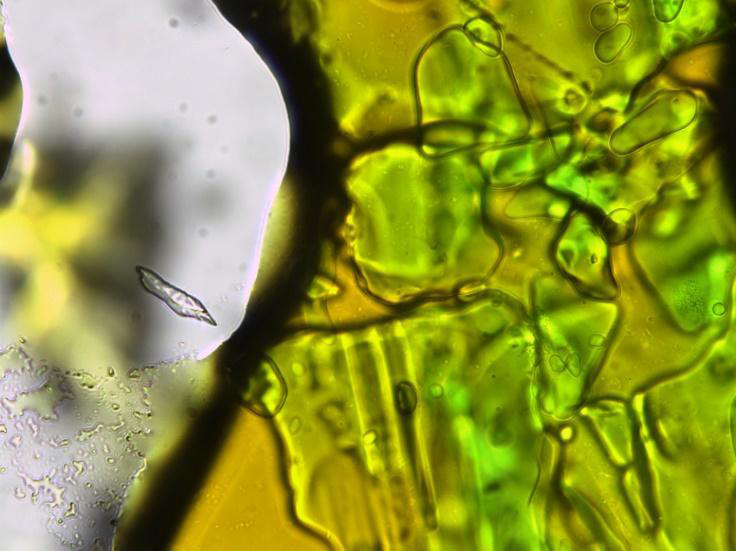
Initial sample of (DEA)2CuCl4 using a 50X objective. The sample has a strong green colour.&nbsp;

Initial sample of (DEA)2CuCl4 using a 50X objective. The sample has a strong green colour. 

Melted sample of (DEA)2CuCl4 &nbsp;at 50°C, note a change in colour from green to an orange-green.&nbsp;

Melted sample of (DEA)2CuCl4  at 50°C, note a change in colour from green to an orange-green. 

Melted sample of (DEA)2CuCl4 at 56°C. Most of the sample has now lost the green colouring.&nbsp;

Melted sample of (DEA)2CuCl4 at 56°C. Most of the sample has now lost the green colouring. 

Fully melted sample of (DEA)2CuCl4 at 70°C, now an orange colour.

Fully melted sample of (DEA)2CuCl4 at 70°C, now an orange colour.

Sample of (DEA)2CuCl4 &nbsp;cooled to room temperature, returning to the original green colour.&nbsp;

Sample of (DEA)2CuCl4  cooled to room temperature, returning to the original green colour. 

Their results showed the thermochromic change to be reversible for (DEA)2CuCl4 . There appears to be slight structural integrity loss after cooling, but the discrepancies are not obvious to the eye and would require microscopic analysis.

Although these particular crystals are not suitable as temperature determinants in food packaging, their study is a great step forward into improving the transportation of goods. Work must now be done in developing a non-toxic thermochromic crystal which has permanent deformation at destructive temperatures.  

We would like to thank Josephine, Taylor and The McCrone group for their innovative study and for kindly sharing their findings with us. 

By Tabassum Mujtaba

Touchdown in Denver

The Sports Authority Field at Mile High in Denver, home of the current NFL champions.&nbsp;

The Sports Authority Field at Mile High in Denver, home of the current NFL champions. 

Our sales team recently visited Colorado for the American Association of Pharmaceutical Scientists (AAPS) 2016 annual meeting.  

Industrial and academic delegates from all over the globe descended on the Mile High city of Denver to attend the meeting which covered a diverse range of topics: from drug product manufacturing and stem cell research, to novel pharmaceutical technology. 

Freeze drying and differential scanning calorimetry (DSC) are important techniques in the pharmaceutical industry and we were excited to be showcasing two new stages at AAPS: the optical DSC450 stage and the freeze-drying vial system FDVS. 

DSC is a technique used to measure temperature and heat flow associated with thermal transitions in materials.  The optical DSC450 system has been optimised to combine the measurement of transition temperatures and enthalpy changes while simultaneously imaging the sample, providing additional information about changes in morphology and colour. 

The Freeze Drying Vial System (FDVS) has been designed as a turn-key solution for simulating the industrial freeze drying process in a compact and efficient form. By incorporating vials, the FDVS works with a small sample volume and uses enough to simulate large scale industrial processes while still minimising sample wastage.

We also brought our humidity controller RH95, freeze drying cryostage FDCS and heating and cooling stage THMS600 which again proved popular within the market. The show reiterated the importance of sample characterisation within the pharmaceutical industry and the role Linkam has within it. 

Ricky Patel and Duncan Stacey outside the McCrone building in Illinois.

Ricky Patel and Duncan Stacey outside the McCrone building in Illinois.

While in the US, we also caught up with our American distributors – the McCrone Group. They graciously showed us around their facilities, including the famous Hooke College and gave us a tour of their private microscopy museum which has a collection of microscopes from the 17th century. We were treated to the delights of Chicago’s famous dining scene - and we are still trying to work off the additional weight!

We would like to give a big thank you to all those who came to see us at the show. We look forward to seeing you at the next pharmaceutical conference.  

By Tabassum Mujtaba