Designing Phosphor-converted White-light-emitting Diodes

The cover of the journal, Chemistry of Materials, highlights a unique phonon projection technique implemented on the yellow emitting phosphor, Y3−xCexAl5O12 (the phosphor applied in most commercial phosphor-converted white LEDs), which provides nove…

The cover of the journal, Chemistry of Materials, highlights a unique phonon projection technique implemented on the yellow emitting phosphor, Y3−xCexAl5O12 (the phosphor applied in most commercial phosphor-converted white LEDs), which provides novel insights into local vibrational dynamics of the crystal and its effects on luminescence properties of the material.

Phosphor-converted white-light-emitting diodes (pc-WLEDs) are efficient light sources used in displays in electronic devices, lamps for indoor and outdoor lighting, and vehicle indicators, to name a few. The most common type of pc-WLEDs comprises an (In,Ga)N-based blue LED and a yellow phosphor, Y3−xCexAl5O12 (YAG:Ce3+), which is electronically excited by the blue LED and followed by yellow light emission. The admixture of the blue and yellow light appears as white light. Hereby, the luminescence properties of the device such as colour temperature, colour rendering index, efficiency, thermal stability, and so on, are strongly dependent on the luminescence performance of YAG:Ce3+.

In YAG:Ce3+, small amounts of the dopant Ce3+ ions serve as luminescent centers, whose electronic structure, which determines the energy transitions of excitation and emission, is predominantly controlled by the local static and dynamical structural environments of the host material, YAG. 

This work from the Chalmers University of Technology focuses particularly on the vibrational dynamics around the Ce3+ ions using vibrational spectroscopy together with DFT-calculations and a unique phonon projection technique. The phonon projection technique is a novel means to interpret lattice vibrations, which allows the qualitative (symmetry) and quantitative (vibrational amplitude) determination of localized vibrations of individual YO8/CeO8, AlO6, and AlO4 moieties in the Y3−xCexAl5O12 crystal, in terms of symmetry coordinates.

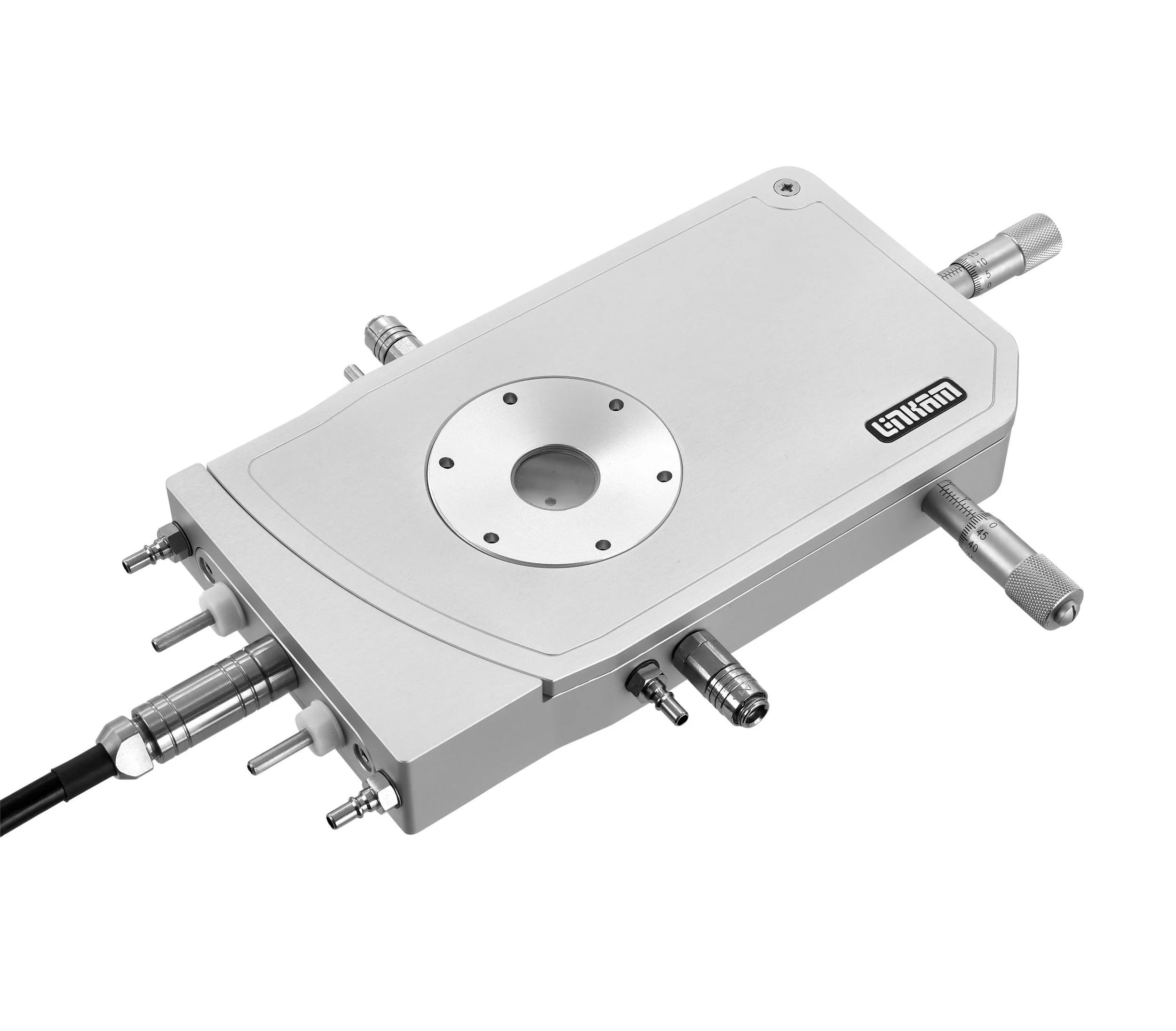
They used the Linkam THMS600 in combination with a commercial Raman spectrometer, to measure temperature-dependent Raman spectra. The results reveal that the studied material, YAG/YAG:Ce3+, remains the same phase in the temperature range of 80 K (-193°C) and 870 K (597°C), however that the frequency of phonon modes changes as a function of temperature. The change in frequency of some specific vibrational modes have been shown to play an important role in the emission colour and luminescence efficiency, especially at high temperature.

The understanding of fundamental structural dynamical properties of one of the most important phosphors in this study, provides a promising design principle, through chemically tuning local static/dynamical structure around the luminescent centers, for developing new phosphors emitting at longer wavelengths, e.g. from greenish-yellow to reddish-yellow emission (to obtain warmer white light from pc-WLEDs), meanwhile exhibiting high luminescence efficiency at high temperature.

Y.-C. Lin, P. Erhart, M. Bettinelli, N. C. George, S. F. Parker, and M. Karlsson, Understanding the Interactions between Vibrational Modes and Excited State Relaxation in Y3–xCexAl5O12: Design Principles for Phosphors Based on 5d–4f Transitions. Chemistry of Materials 2018 30 (6), 1865-1877 DOI: 10.1021/acs.chemmater.7b04348
 

Tuning Phosphorous Allotropes for Optoelectronics

An optical image of black phosporus mid-IR photodetector.

An optical image of black phosporus mid-IR photodetector.

The element phosphorus has several different allotropes, including the thermodynamically stable form, black phosphorus (BP). BP has interesting properties which make it useful for the optoelectrical field, such as its layered structure, bandgap in the mid-infrared range and high carrier mobility. 

HgxCd(1-x)Te (MCT) is generally regarded as the most popular mid-infrared material, whose composition can be tuned by in material growth process. However dynamical, in-situ tuning of its optical properties has never been achieved, limiting its ability. 

In this paper, researchers discovered black phosphorus could be useful for in-situ tunable mid-infrared applications. They leveraged a thin layer of black phosphorus sandwiched between hexagonal boron nitride (HBN) and applied an electric field to tune its optical properties. This expanded the photo-response of the mid-infrared photodetectors from 3.7 to 7.7 µm. Other than photodetectors, high speed mid-infrared modulators can be readily constructed using the same concept. 

They used the heating and cooling probe stage, the HFS600E-PB4, together with an FTIR spectrometer for the temperature-dependent photo-response measurements. 

Their results prove promising. The layered nature of BP, the high intrinsic mobility and strong photo-response in the broad mid-IR wavelength range make it an ideal material for high-speed mid-IR photodetectors, modulators and spectrometers. 
 

By Tabassum Mujtaba

Xia et al., Widely tunable black phosphorus mid-infrared photodetector. (2017) Nature Communicationsvolume 8, Article number: 1672 doi:10.1038/s41467-017-01978-3

Studying Phase Transitions in Pharmaceuticals with the Linkam DSC450

Dr Asma Buanz

UCL School of Pharmacy, University College London, 29-39 Brunswick Square, London, WC1N 1AX

Background

Polymorphism in pharmaceutical solids has great implications on both the processing and the performance of solid pharmaceutical products. It is the ability of a substance to exist in more than one molecular arrangement and the result is more than one polymorphic forms which differ in their physiochemical properties such as solubility, stability, melting point etc.1 Depending on these arrangements the polymorphic forms could vary in their relative stabilities; with the metastable forms eventually converting to the most stable form.1,2. Studying these phase transformations is important in understanding the properties of these polymorphic forms. Various techniques could be employed for this purpose but Differential Scanning Colorimetry is the most common and efficient technique as it allows following these transformations as a function of temperature or time, in addition to its high sensitivity.3 Nonetheless, sometimes it is difficult to build a clear picture of what is happening to the sample as it goes through a phase transition from just the heat flow signal provided by the DSC, and thus visualising these processes would be valuable. In addition, subtle transitions such as solid-solid transitions could be missed in the DSC if they happen over a wide temperature range.

Method

The Linkam DSC450 stage allows visualisation of the sample during a DSC experiment. Therefore, this system was used in studying flufenamic acid, one of the most polymorphic pharmaceuticals with a record of nine known polymorphic forms2. The aim was to study crystallisation from the amorphous phase obtained by melt quenching. Form I was obtained by spray drying and was first heated in the DSC450 up to the melt, then it was allowed to cool down to room temperature before re-heating at a 10 °C/min heating rate.

Results

As shown in Figure 1, form I melted at ca. 132 °C while the re-heated sample melted at a lower temperature (onset of ca. 122 °C). No re-crystallisation was observed in the second heating cycle, which indicated that upon cooling a metastable form recrystallised from the melt. 

Asma graph 1.jpg

The effect of adding a polymer (PVP) is evident in Figure 2 where it appeared that the sample did not crystallise upon cooling but rather formed an amorphous phase. Heating the amorphous phase caused there-crystallisation of FFA followed by a solid-solid transition and then a melt. These events appear as two exothermic transitions followed by a sharp endotherm. The solid-solid transition is subtle in the DSC thermogram but is very clear from the signal obtained from employing an image analysis technique (Thermal Analysis by Surface Characterization, TASC) shown in Figure 2c. The melting peak has an onset temperature of ca. 119 °C, which is lower than that of the form crystallised from the melt without the presence of the polymer. The TASC signal also shows that melting is detected visually before the DSC signal starts to change.

Asma graph 2.jpg

Conclusion

In this work polymorphic transitions in the pharmaceutical active flufenamic acid were studied with Linkam DSC450 stage, which combines optical microscopy with differential scanning calorimetry. The power of the complementary technique was evident with the increased sensitivity for detecting subtle transitions such as solid-solid transition by analysing the optical images.

References

1. Rodrı́g uez-Spong, B., Price, C. P., Jayasankar, A., Matzger, A. J. and Rodrı́guez-Hornedo, N. r. 2004. General principles of pharmaceutical solid polymorphism: A supramolecular perspective. Advanced Drug Delivery Reviews 56(3): 241-274.

2. López-Mejías, V., Kampf, J. W. and Matzger, A. J. 2012. Nonamorphism in flufenamic acid and a new record for a polymorphic compound with solved structures. Journal of the American Chemical Society 134(24): 9872-9875.

3. Gaisford, S. and Saunders, M. 2012. Physical form i – crystalline materials. Essentials of pharmaceutical preformulation, John Wiley & Sons, Ltd: 127-155.

Exploring plasmon-actuated nano-asssembled microshells using a Linkam hotstage

LTS420 shown above

Nanomaterials have been found to have interesting electronic, magnetic and optical properties. They can manipulate electromagnetic fields through localised surface plasmon resonance to modulate light interactions. Such plasmonic phenomena are popular in application for the biomedical field. 

Researchers from the University of California, Merced and Stanford University in the USA developed a micro-scale delivery module for various organic and inorganic compounds using nanomaterials. 

Their aim was to create something that would be versatile and capable of encapsulating a range of different materials (drugs, dyes, cells, bacteria, etc.) for many different applications. These could include drug delivery for cancer treatment, releasing dyes in vivo for fluorescence imaging, or tissue engineering. The problem with existing platforms is that they are either leaky, unable to hold the contents without loss for any prolonged period, or they are incapable of releasing contents in a spatially and temporally controlled manner. For example, other cargo delivery systems that use light to activate the release of the cargo need several milliwatts of power over several minutes to achieve the required effect, therefore creating significant localised heating. The group managed to reduce the power required to less than 2 mW and the release time to under 5 seconds. As a result, the total temperature increase at the vicinity of the capsules is only to ~ 40°C, which is well within tolerable limits for many biological systems.

The team used an LTS350*,(now superseeded by the LTS420), for their experiments. When asked on the importance of the hotstage, Dr Ghosh said: “One of the most critical parameters that determine whether a cargo delivery system is viable in vivo is the thermal gradient that is produced because of the photothermal effect when optical excitation used to rupture the shells is in resonance with the plasmonic response of the nanoparticles that make up the shell walls. To estimate this, the first step was to use heat to rupture the shells instead of light. That is where we used the heating stage.”
 

Fluorescence microscopy images of a Nano-Assembled Microshell loaded with a fuorescent dye on the LTS350 stage. 

Fluorescence microscopy images of a Nano-Assembled Microshell loaded with a fuorescent dye on the LTS350 stage. 

Their method has proved to be exciting and advantageous. No leakage was seen for over five months after encapsulation, promising a long shelf life. Furthermore, a lower optical intensity was required for shell disintegration compared to other methods. 

Although more work is required to improve future in-vivo applications (such as actuation by near infra-red and reducing overall size of capsule), their work is a promising result for future cargo delivery systems. 

Find out more about the research here

*The LTS350 has been superseded by the LTS420 offering a large temperature range and better temperature control to 0.01°C.