
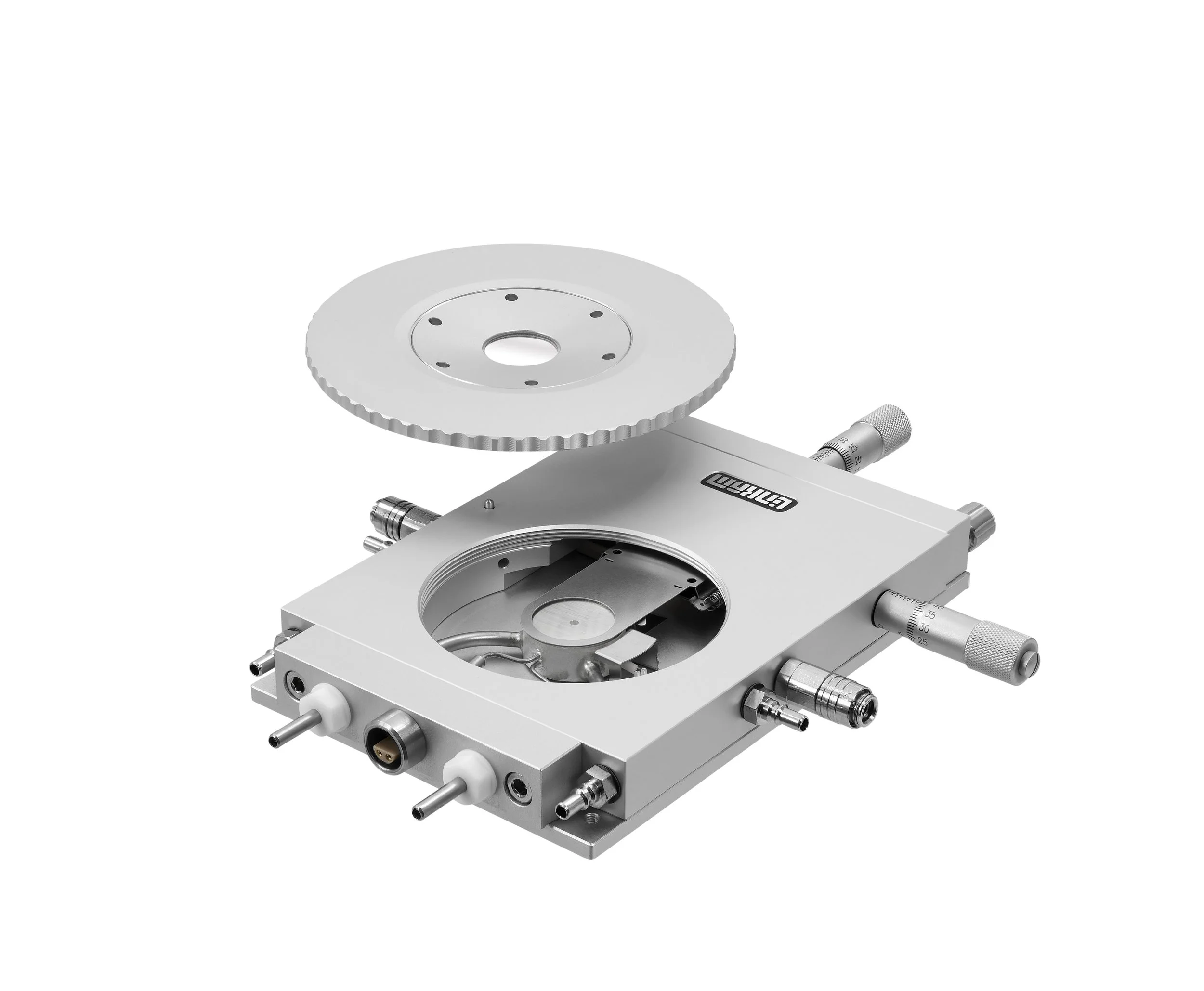
THMS600 shown above
Researchers at Aristotle University of Thessaloniki, NatPro-AUTH, CIRI-AUTH, in Greece have published a study investigating how different combinations of amphiphilic polymers influence the formation, physical stability, and dissolution performance of ternary amorphous solid dispersions (ASDs) of griseofulvin (GRF), a poorly soluble drug with a strong tendency to recrystallise.
Using a wide range of characterisation methods (DSC, ATR-FTIR, NMR, PXRD, PLM, dissolution testing), the authors show that certain polymer combinations, especially HPMCAS + HPC/SL and HPMCAS + PVPVA, create stronger molecular interactions with GRF. These interactions slow down molecular mobility, inhibit recrystallisation, and significantly enhance supersaturation during dissolution.
Linkam’s THMS600 temperature-controlled stage was used extensively for hot-stage polarised light microscopy (HSM), a critical technique in the study. It supported two major experimental components:
1. Melt Miscibility Assessment
In the miscibility evaluation section, samples were heated from room temperature to complete melting at 10 °C/min on the THMS600.
Purpose:
To visually observe whether GRF and polymers formed a homogeneous melt.
To check for signs of immiscibility (e.g., liquid-liquid phase separation).
Outcome enabled by THMS600:
The stage provided controlled heating and optical clarity that allowed the researchers to confirm that all polymers and polymer combinations were fully miscible with GRF in the melt, a key requirement for successful ASD formation.
2. Crystal Growth Rate (CGR) Measurements
Hot-stage microscopy using the THMS600 enabled the researchers to:
Melt physical mixtures just above the drug’s melting point.
Rapidly cool them to form amorphous samples.
Seed with GRF crystals.
Observe crystal growth at 110 °C in real time.
This produced quantitative CGR values for each polymer system.
Outcome enabled by THMS600:
The high thermal precision and fast temperature transitions allowed reproducible measurements of crystal growth inhibition, revealing that:
HPMCAS-based systems (binary or ternary) slow crystal growth the most.
Some polymer combinations dramatically outperform single polymers.
This hot-stage experiment was essential for identifying synergistic polymer interactions.
Read the full paper here